The mercury dime value most owners ask about comes from two parts: the silver inside the coin and any collector demand on top of it.
The U.S. Mint struck Mercury dimes from 1916 to 1945, and each one is 90% silver. That means even a worn coin has a melt value well above its 10-cent face value.
This blog explains how to work out melt value, which dates and conditions add a premium, and how to check a coin before buying or selling.
How Much Silver Is in a Mercury Dime?
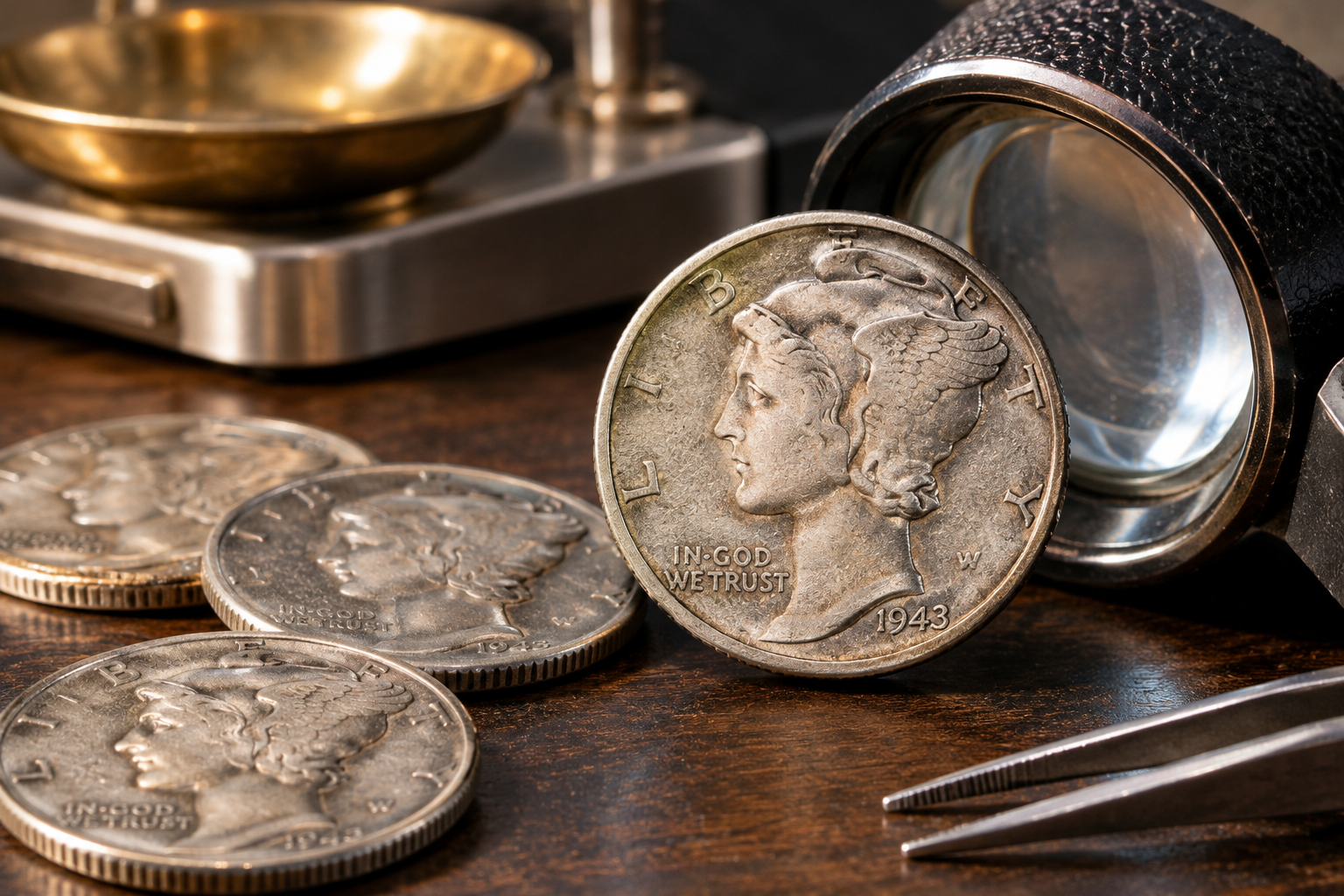
A Mercury dime is 90% silver and 10% copper. It weighs about 2.5 grams and holds 0.07234 troy ounces of pure silver. Sculptor Adolph A. Weinman designed the coin, which is formally called the Winged Liberty Head dime. The Mercury nickname comes from the winged cap, which many people mistook for the Roman god Mercury.
Roosevelt dimes replaced the design in 1946, and Roosevelt dimes dated 1964 or earlier are also 90% silver. Dimes made after 1964 are copper-nickel clad and hold no silver. Coins that carry 90% silver are often called junk silver because most are bought for metal content, not rarity. That silver content is the starting point for every pricing decision.
How to Calculate Mercury Dime Melt Value
Melt value is the silver content multiplied by the spot silver price. Use these two formulas:
One Dime: 0.07234 × spot price per troy ounce
$1 Face Value (10 dimes): 0.7234 × spot price per troy ounce
For instance, if the spot price of silver was $30 per ounce, one dime would have a melt value of about $2.17, and ten dimes would be worth about $21.70. It should be noted that this figure is for illustrative purposes only and you should check the current spot silver price before doing the calculation since the melt value changes with the market.
Dealers typically give the price of a coin or a group of coins as a percentage of their melt value, so it's useful to know the base figure when assessing any offer. As wear slightly reduces the actual silver content, treat the formula as an approximation for circulated coins.
What Adds Collector Premiums to Mercury Dimes?
Collector premiums lift mercury dime value above melt when a coin is scarce, sharp, or well preserved. Three factors matter most: date and mint mark, condition, and third-party grading. The U.S. Mint struck the series at Philadelphia, Denver, and San Francisco, and the number of coins made at each mint explains why some dates cost far more than others.
Key Dates and Mint Marks
The number of coins produced determines their rarity. The 1916-D is the best-known key date and had only 264,000 minted at the Denver Mint. Scarcity also applies to the 1921 and 1921-D issues. Coins with common dates from the 1930s and 1940s generally sell near their melt value in circulated condition.
The mint mark is on the reverse side, to the left of the fasces, so you should look in that area first. A coin that lacks a mint mark came from the Philadelphia Mint, whereas D indicates it came from Denver and S means it came from San Francisco. People pay more for a rare date only if the coin is authentic and unaltered.
Condition and Full Split Bands
Coins with sharp detail carry higher premiums than worn ones. Collectors also prefer Full Split Bands, which occur when the two horizontal bands on the fasces on the reverse side are completely separated. Grading a coin with services like PCGS or NGC provides greater confidence, especially for higher-grade coins.
Heavily worn, cleaned, or damaged dimes generally sell at or near their melt value and do not command a collector's premium. A coin with crisp lines in the wings and hair will attract more interest than a worn, smooth one, even if both share the same date.
Melt Value vs. Collector Premium: Which One Applies?
Most Mercury dimes in circulated condition are priced on silver content. A smaller group earns more because of date, grade, or strike. A sound approach is to price the coin at melt value first, then ask whether anything about it justifies more. This table shows how each type is usually priced.
How to Check a Mercury Dime Before You Buy or Sell
Start by checking the date, mint mark, and weight; a real Mercury dime weighs about 2.5 grams. Since fake coins do exist, testing is useful when dealing with large quantities. The coins should be stored in a soft holder, picked up by their edges, and neither polished nor wiped.
Pacific Precious Metals offers XRF assaying, which shows the metal makeup of an item, at $15 per item for one to five items. The four Bay Area stores in Sausalito, Palo Alto, Fremont, and Walnut Creek also evaluate items based on purity, weight, and current spot prices.
Frequently Asked Questions
Are all Mercury dimes worth more than face value?
Mercury dime is 90% silver, worn coins still have a melting value well above 10 cents; rare dates and those in high grades can fetch a price higher than the melting value.
How many Mercury dimes make one ounce of silver?
It takes about 13.8 Mercury dimes to reach one troy ounce of pure silver, based on 0.07234 ounces of silver per coin.
Is the 1916-D the only valuable Mercury dime?
No. The 1921 and 1921-D are also scarce, and coins with Full Split Bands or high grades can sell above melt value too.
Should I clean a Mercury dime before selling it?
No. Cleaning the mercury dime can scratch the surface and reduce collector appeal. Leave the coin as it is and have it evaluated.
Know What You Hold Before You Buy or Sell
Mercury dime value comes down to melt value first and collector premium second. Common dates follow silver content, while key dates and sharp strikes can earn more.
Bay Area owners can bring coins to any Pacific Precious Metals store for an in-store evaluation.
Disclaimer: This content is provided by Pacific Precious Metals for educational purposes only and is not financial or tax advice. Precious metals carry risk, including possible loss of principal, so please consult a licensed advisor before investing.